
Strength training over 40: everything beginners need to know
Never lifted before? This complete beginner's guide to strength training over 40 covers what to do, what to avoid, and how to get strong without getting hurt.
Why strength training matters more after 40, not less
Here's something most people don't hear until it's too late: from your early thirties onwards, you lose between 3% and 8% of your muscle mass every decade. After 40, that loss accelerates. After 50, it accelerates again. Researchers have a clinical name for it — sarcopenia — but the everyday word is frailty, and it sneaks up on people quietly. You don't notice it until you're 58, struggling with a heavy suitcase at an airport, and wondering when stairs got harder.
The good news, and it really is good news, is this: every single bit of that decline can be slowed, halted, or reversed. Not with a magic supplement. Not with hours of cardio. With strength training.
I've been coaching people in their 40s, 50s, and 60s for 15 years now, and I can tell you the people who walk into a gym for the first time at 52 are the ones who get the biggest, most life-changing results. They sleep better. Their joints stop creaking. The back pain they assumed was permanent fades. They stop wincing when they pick up a grandkid.
Take Mitsue. She walked into my gym at 69 — a 45kg woman who'd never picked up a barbell in her life. Four and a bit years later, she pulls 62.5kg off the floor. That's more than her own bodyweight, deadlifted clean, at 73. We also train handstands together, because balance and whole-body strength don't come from machines and they don't come for free as you age — they have to be earned.
Most people read that and assume Mitsue must be exceptional. She isn't, particularly. She's just consistent. Two sessions a week, every week, for four years. Showing up when her hip ached. Showing up the week after a holiday. Showing up while other 70-something women in her circle were starting to talk seriously about hip replacements, walking aids, and "slowing down." She didn't slow down. She got stronger.
This guide is for the person who's never lifted a weight in their life, or hasn't in twenty years, and is wondering whether it's worth starting now. Spoiler: it is. By the end of this article you'll know exactly what strength training is, what it isn't, what to do in your first session, what to expect over your first 12 weeks, and how to do it without getting hurt.
Let's start by clearing out the rubbish you've probably heard.
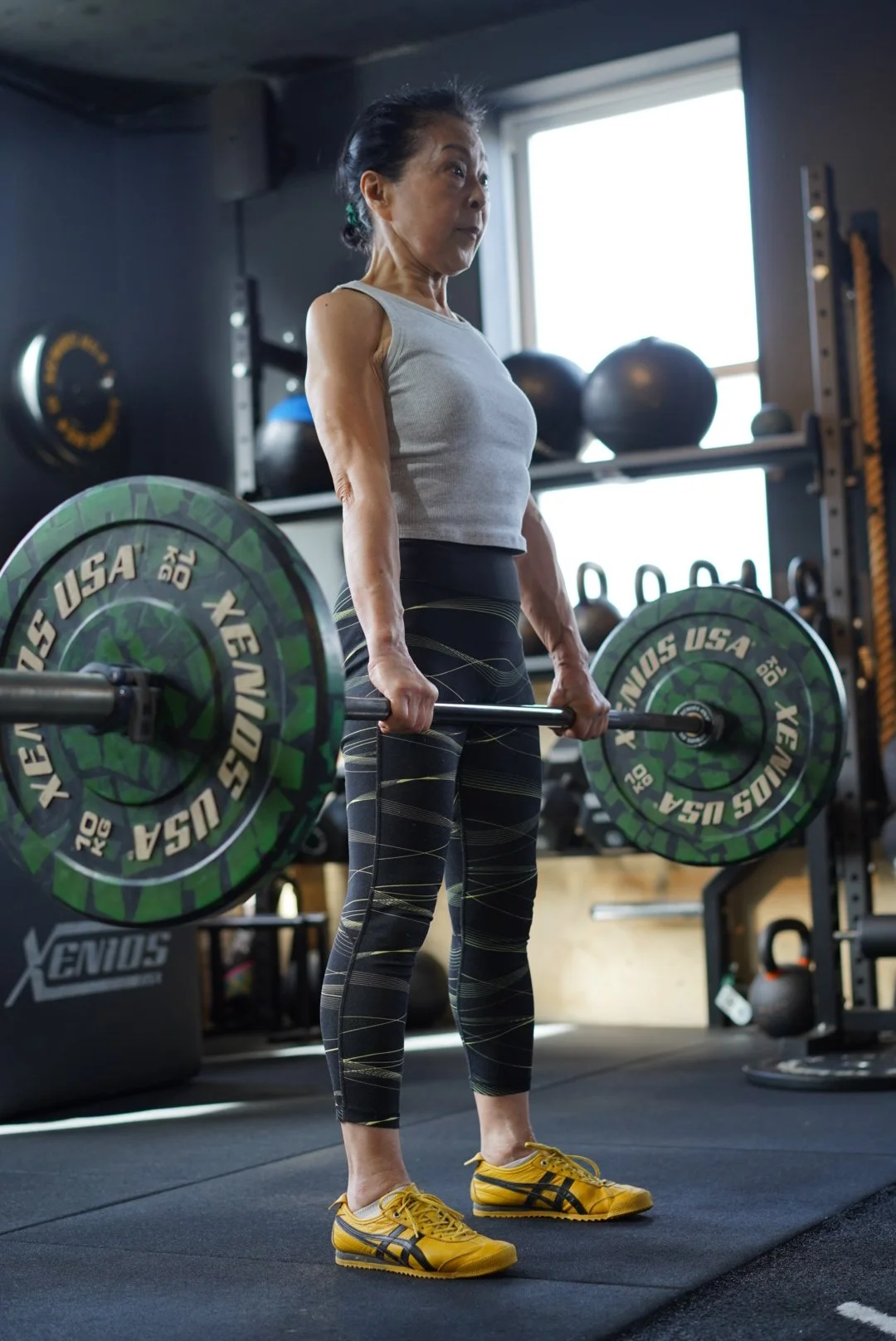
“i feel the strongest i’ve
ever been at 73” mitsue
The 5 myths keeping people over 40 out of the gym
Myth 1: "I'll bulk up and look like a bodybuilder"
You won't. Building visible muscle mass takes years of dedicated training, very specific eating, and — for most men — a level of testosterone you no longer have in your forties without help. For women over 40, it's even less of a concern: oestrogen drops, recovery slows, and the hormonal environment for "bulking up" simply isn't there.
What you'll actually look like is firmer. Less soft. More defined. Most of my female clients in their 50s tell me the same thing six months in: "I look like I always did, just better — and I can carry my own shopping."
Myth 2: "It's too late to start"
A study from the University of Alabama at Birmingham put 60-72 year-olds on a strength programme for 16 weeks. They gained roughly the same amount of muscle as 20-year-olds doing the same programme. Read that sentence twice. Your body doesn't have an expiry date on muscle growth. The mechanism still works. The only difference is recovery takes a bit longer — which means you train smarter, not harder.
Myth 3: "Lifting weights is dangerous for older joints"
Properly programmed strength training is protective of your joints, not destructive. Strong muscles around a joint absorb the loads that would otherwise transmit into the cartilage and bone. People with knee pain who lift consistently end up with less knee pain, not more.
The dangerous activity for someone over 40 isn't lifting weights — it's not lifting weights and gradually losing the ability to catch yourself when you stumble.
Myth 4: "I need to do cardio first to lose weight"
Cardio burns calories during the activity. Strength training builds muscle that burns calories all day, every day, while you sleep, while you watch telly, forever. If body composition is your goal — and for most of my over-40 clients it is — strength training is the bigger lever, by a long way. Cardio's still useful. It just isn't the main event.
Myth 5: "I'm too unfit / inflexible / out of shape to start"
Everyone starts where they are. I've started clients who couldn't squat to a chair. Within four weeks they could. The starting line is wherever you currently stand — there's no minimum entry requirement.
Before you start: 4 things to check
Should you see a doctor first?
If you have a heart condition, uncontrolled high blood pressure, recent surgery, or an active injury, yes — talk to your GP first, and ideally a physio if there's specific damage. For everyone else, it's less clinical: if you can climb a flight of stairs without serious distress, you can start a beginner strength programme.
An honest mobility check
Try these three things in your living room:
Can you squat down to sit on a chair, then stand up, without pushing off your knees?
Can you bend forward and touch somewhere between your knees and your toes?
Can you raise both arms straight up overhead without back pain?
If any of these are difficult, you're not disqualified — you just need to factor in some mobility work alongside your strength training. My 5-minute over-40 mobility flow is a good place to start.
Equipment: gym, home, or hybrid?
A commercial gym gives you variety and ready equipment. The downside is the drive, the membership, and the self-consciousness most beginners feel walking past 25-year-olds doing things you can't yet do.
A home setup with a couple of dumbbells and a resistance band can deliver 95% of the result for 5% of the friction. For most over-40 beginners who tell me "I'll never get to a gym consistently," I recommend starting at home and building the habit before worrying about equipment. I've written a home strength starter guide that covers exactly what to buy.
Setting realistic expectations
Week 4: You'll feel a real difference in how you carry yourself. Stairs feel easier. You sleep better.
Week 12: You'll be measurably stronger — same exercises, more weight, more reps, less effort.
Six months: Body composition starts shifting. You'll notice it before anyone else does.
One year: Friends start asking what you've been doing.
If anyone promises you a dramatic transformation in six weeks, walk away. They're selling something.
The beginner's framework — 5 lifts to build everything around
Forget machines. Forget complicated routines. Five movement patterns cover almost everything a human body needs to do in real life.
1. Squat (or sit-to-stand)
What it is: Lowering your hips down and standing back up — the same movement as getting out of a chair. Why it matters: Strong squats translate directly to climbing stairs, getting up off the floor, and not falling. Common mistake:Letting the knees collapse inward. Push them out as you stand. Easier version: Sit-to-stand from a chair, hands on thighs.Harder version: Goblet squat holding a kettlebell or dumbbell at your chest.
2. Hinge (hip hinge)
What it is: Bending forward from the hips while keeping your back flat, then standing back up. Why it matters: This is the single most important movement for back health. Most lower back pain is hinge dysfunction. Common mistake:Rounding the lower back instead of hinging the hips. Easier version: Hip hinge with no weight, hands sliding down your thighs. Harder version: Romanian deadlift with light dumbbells.
3. Push (push-up or dumbbell press)
What it is: Pushing weight away from your chest. Why it matters: Builds the chest, shoulders, and triceps you need for everyday tasks like opening a stiff door or pushing a heavy trolley. Common mistake: Flaring the elbows out wide.Easier version: Push-up against a wall, then a kitchen counter, then a step. Harder version: Dumbbell bench press lying on your back.
4. Pull (row)
What it is: Pulling weight toward your body — the opposite of a push. Why it matters: Counters the rounded-shoulder posture most of us develop from desk work and phones. Also builds the back muscles that support a healthy spine.Common mistake: Shrugging the shoulders up to the ears. Easier version: Banded row anchored to a door. Harder version: Dumbbell row with one knee on a bench.
5. Carry (suitcase or farmer's carry)
What it is: Picking up a weight in one or both hands and walking with it. Why it matters: Real-world strength. Also builds grip, core, and shoulder stability — three things that decline noticeably after 40. Common mistake: Leaning to the side to compensate. Stay tall. Easier version: Carry a single light dumbbell for 20 seconds. Harder version: Heavy farmer's carries for 40-50 metres.
These five movements aren't random gym exercises. They're the patterns your body is built for. Get strong in all five and you've covered 90% of what life will ever ask you to do physically.
[INSERT INFOGRAPHIC: "The 5 movements at a glance" — design with /adobe-for-creativity:adobe-design-from-template]
How to structure your first 12 weeks
Weeks 1-4: Learn the movements
2 sessions per week, with at least one day off between
30 minutes maximum per session
Light weight — lighter than you think
Focus entirely on form
A sample session: 5-minute warm-up, then 3 sets of 8-10 reps for each of squat, push, pull, hinge, and carry. Cool down. Done.
Weeks 5-8: Add load
Same exercises, slightly heavier weight or slightly more reps
Still 2 sessions per week, optionally bumping to 3
The rule: when you can do 3 sets of 10 reps comfortably, add a small amount of weight next session
Weeks 9-12: Build consistency
3 sessions per week is the sweet spot for most over-40 beginners
Slowly introduce some variations of the same five movements
Start tracking your lifts in a notebook or app — this is when noticeable progress happens
How heavy should you actually lift?
Forget "1RM," forget percentages. Use this rule:
The last two reps of each set should feel hard but doable, with another 1-2 reps "in reserve."
If you can do 12 reps and feel you could keep going, the weight is too light. If you grind out 8 reps with shaky form, it's too heavy. The sweet spot is somewhere in between. As you train more, you'll calibrate this almost automatically.
Recovery, sleep, and protein — the boring things that actually matter most
This is where most beginners over 40 quietly sabotage themselves. They train hard, then sleep six hours, eat 50g of protein a day, and wonder why nothing's changing.
Rest between sessions
At least one full day off between strength sessions. Two if you're sore. Your muscles don't grow during the workout — they grow during the recovery.
Protein
The official UK guideline (0.8g per kg of bodyweight) was set decades ago and is too low for anyone training for muscle, particularly over 40. Aim for 1.6-2.0 grams per kg of bodyweight per day. For a 70kg person, that's 110-140g of protein daily — roughly a palm-sized portion at every meal plus one snack.
Sleep
Non-negotiable. 7-9 hours. The strongest, leanest, most consistent over-40 clients I've ever coached share exactly one habit, and it's that they sleep well. There is no substitute, no supplement, no shortcut.
Strength training when something already hurts
Most people over 40 have something — a knee, a shoulder, a back, a hip — that's a bit cranky. That's not a reason to skip strength training. It's a reason to modify it intelligently.
The general principle: train around the pain, not into it. If a movement hurts, find a version that doesn't. There almost always is one.
Dodgy knees? Box squats and step-ups often work better than free squats. (Full guide here.)
Lower back? Master the hinge with no weight before adding any. Avoid spinal flexion under load.
Shoulders? Neutral-grip presses (palms facing each other) and band pull-aparts are usually safe.
Hips? Glute bridges before squats. Hip mobility before hinges.
If something hurts sharply or persistently, see a physio. Don't push through.
Strength training for women over 40 — does it need to be different?
Programming-wise, no. The same five movements, the same progression. Context-wise, sometimes.
Three things matter more for women in their 40s and 50s:
Bone density. Women lose bone density rapidly during and after menopause. Strength training is the single most effective non-pharmaceutical intervention against osteoporosis. This isn't optional — it's preventive medicine.
Hormonal recovery. Perimenopausal and menopausal women may need slightly more recovery between sessions, particularly if sleep is disrupted.
Joint pain from oestrogen drop. Many women in this stage develop achy joints they've never had before. Strength training helps. Mobility work alongside it helps more. (My over-40 mobility article goes deeper here.)
The "women's-only programme" industry sells a lot of pink dumbbells and 1lb weights. Ignore it. Lift the same way as anyone else, just with the recovery and bone-density angles in mind.
Common mistakes beginners over 40 make
Going too hard, too fast. The first session shouldn't leave you unable to walk. Build slowly. Consistency beats intensity for the first 12 weeks.
Skipping warm-ups. A 5-minute warm-up is non-negotiable when you're 47 and not 22. Five minutes of easy movement saves you from a strain that takes six weeks to heal.
Comparing yourself to 25-year-olds on Instagram. They're a different sport. Your benchmark is you, last month.
Doing only what you're already good at. If you hate squats, you need them more, not less.
Quitting at week 3. This is when motivation dips and visible change hasn't arrived yet. Push through. Week 4 is when most people start feeling their first real wins.
Frequently asked questions
How long until I see results? Strength gains in 4 weeks. Postural and "I feel better" changes in 6. Visible body composition shifts in 12. Friends asking what you've been doing in 6-9 months.
Do I need to do cardio too? Some, yes — for heart health. But strength training does most of the body-composition work. 2-3 strength sessions and 2 walks a week is a complete programme.
What if I've got osteoarthritis or joint pain? Strength training, properly modified, usually improves both. See a physio for diagnosis, then lift around the pain.
Is it ever too late to start? No. People in their 80s build muscle. Genuinely.
How many days a week should I train? 2-3 strength sessions. More than 4 is unnecessary for almost everyone over 40.
What's the difference between strength training and weight training? None worth caring about. Different words for the same thing.
Should I lift heavy or light? Heavy enough that the last 2 reps are hard but doable. The exact number on the dumbbell matters less than the effort level.
Your next steps
You now know more about strength training over 40 than 95% of people who walk into a gym for the first time. The remaining gap between this knowledge and being a person who lifts twice a week is small — and entirely habitual.
Start simple. Two sessions next week. The five movements, light weight, 30 minutes. Don't overthink it.
If you want a structured programme to follow without the planning, I've put together a free 5-Day Beginner Strength Starter — drop your email below and I'll send it over. It's the exact protocol I use with my new in-person clients in their first week.
[INSERT EMAIL CAPTURE FORM]
If you'd rather work with me directly, you can book a free consultation and we'll build you a 1:1 programme around your goals, your kit, and whatever your body's currently bringing to the table.
Strong is a habit. The first session is the hardest. After that, it's just turning up.
— Steve